Summary:
Episode: Strength Running Podcast, Episode 430
Guest: Nick Thompson — CEO of The Atlantic, world-ranked ultrarunner, 40-44 age group 50k American record holder
Host: Jason Fitzgerald — USATF-certified running coach, founder of Strength Running
Book: The Running Ground: A Father, a Son, and the Simplest of Sports
Core topic: How masters runners can find breakthroughs, sustain motivation over decades, and train smarter in their 40s and beyond
Key themes: Father-son relationships and running, masters training evolution, cancer diagnosis and resilience, passing running on to your children, training with elite coaches
Who this is for: Masters runners, competitive runners seeking longevity, anyone looking to reconnect with their motivation after years of racing
Actionable takeaways: Train with a group and elite coaching, stop treating training as a hobby, embrace the process of structured periodization as an older athlete
Training for Decades
I’ve been coaching runners since 2010, and one question comes up more than almost any other: how do you keep going? How do you stay motivated after years — sometimes decades — of training, racing, injury, and recovery? How do you get faster as you get older, when everything in conventional wisdom says you shouldn’t?
Nick Thompson has answers. And his story is unlike almost anything I’ve encountered in this sport.
Nick is the CEO of The Atlantic, a world-ranked ultrarunner, and the 40-44 age group American record holder in the 50k — finishing 31 miles at 5:56 per mile. He’s been racing for more than 35 years. And at an age when most competitive runners are scaling back expectations, Nick was setting records and reaching the peak of his athletic career.
His new book, The Running Ground: A Father, a Son, and the Simplest of Sports, is the kind of running memoir that goes far beyond splits and training logs. It’s about fathers and sons, identity and illness, and the strange, sustaining power of a sport that asks very little and gives back enormously. It’s a hell of a book — and I was genuinely glad to sit down with Nick for Episode 430 of the Strength Running Podcast.
Meet the Guest: Nick Thompson, CEO of The Atlantic
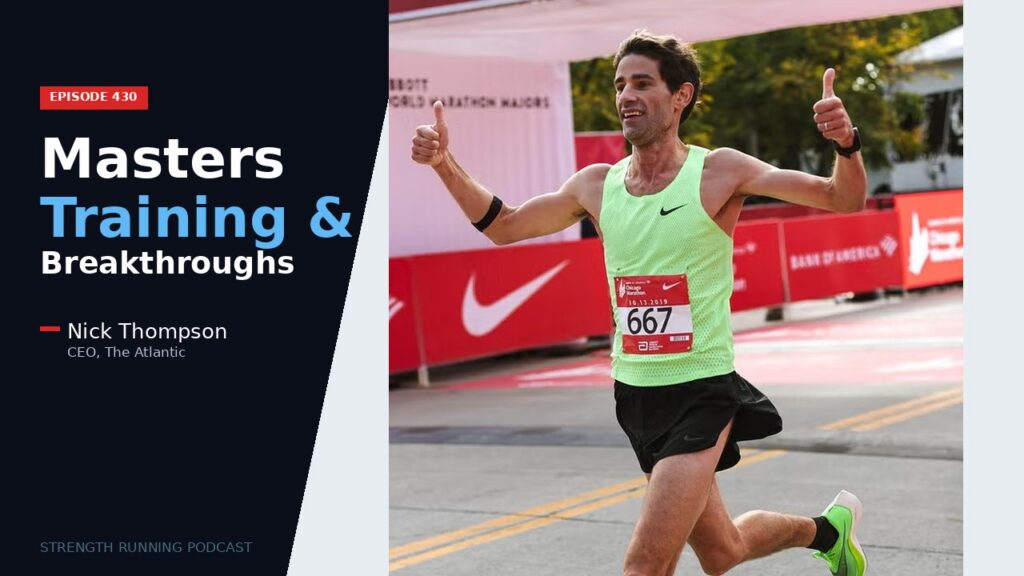
Nick Thompson’s running résumé is remarkable on its own terms. He’s a 3:04 50k finisher — that’s 5:56 per mile for 31 miles — and the former world’s top-ranked runner in his age group in the 50-mile. He’s been competing at a high level since his twenties, and rather than declining gracefully into recreational running, he got faster. Significantly faster.
But Nick’s professional life is equally extraordinary. As CEO of The Atlantic, one of America’s most storied publications, he operates at the intersection of journalism, technology, and culture — a world that moves fast and demands the same kind of sustained focus that elite running requires.
What makes Nick unusual isn’t just that he runs fast or leads a major media company. It’s that he’s thought deeply about why he runs, how his relationship with the sport has changed, and what it actually takes to improve at an age when most athletes assume they’ve already peaked.
His book grew out of a relationship with his father, with running, and with himself that spans decades.
The Story Behind the Book
The Running Ground begins with Nick’s father, and that’s where our conversation begins too. Nick’s dad was both an inspiration and, in some ways, a cautionary tale — someone whose relationship with running shaped his son’s, for better and for worse. Understanding that dynamic, Nick told me, is essential to understanding why he still laces up every day.
I’m a father of three myself, and this part of the conversation hit close to home. I’ve thought a lot about how to pass along a love of running to my own kids without making it feel like a burden or an obligation. Hopefully, my kids see me in my short shorts and realize that they too want this life. Nick has navigated that same tension, and his perspective — thoughtful, honest, and occasionally funny — is one of the most useful things I’ve heard on the subject.
The book also deals unflinchingly with Nick’s cancer diagnosis roughly twenty years ago. A health crisis of that magnitude tends to recalibrate everything, and running was no exception. What Nick discovered was that illness didn’t diminish his relationship with the sport — it deepened it, in ways that took years to fully understand.
What the Episode Covers
The conversation spans a lot of ground, anchored throughout by the question of what it takes to keep running well over a long career.
The father-son foundation. Nick traces his relationship with running back to his father — a good influence, a complicated one, and ultimately the person who handed him the sport. Understanding where motivation comes from is the first step toward sustaining it, and Nick’s origin story is more nuanced than most.
Passing it on to your kids. We both have three kids, and neither of us wants to be the overbearing running dad who turns a joyful sport into a chore. Nick has thought carefully about how to share something he loves without imposing it, and his approach offers a useful framework for any running parent.
Decades of motivation. Nick has been racing for 35 years at a high level. The things that drive him today are not the things that drove him at 22. We dig into how motivation evolves over a long athletic career, what he’s learned about sustaining it through injury and illness and life, and why he thinks the sport keeps giving back even as the body changes.
Cancer and running. Nick was diagnosed with cancer about twenty years ago. He’s candid about how that experience shifted his relationship with the sport — not in the way you might expect, but in a way that made running feel more essential, not less.
Training like a dilettante. Nick describes his training in his twenties as that of a dilettante — someone going through the motions without real structure or intention. I wanted to understand exactly what he meant by that, because I think a lot of masters runners are in that same position right now and don’t fully realize it.
The breakthrough. The arc of Nick’s story builds toward something genuinely inspiring: a masters athlete who started training with elite coaches, rebuilt his approach from the ground up, and began running personal records at 44 before setting an American age-group record at 46. We spend real time on the before-and-after — what changed, why it worked, and what other masters runners can take from it.
Advice for masters comebacks. Nick closes with something I know a lot of our listeners are thinking about: what does a real comeback look like at 40, 45, or 50? His answer is practical, honest, and more hopeful than you might expect.
Why This Conversation Matters
There’s a particular kind of discouragement that sets in for competitive runners in their forties. The PRs from your twenties start to feel like relics. Recovery takes longer. The gap between where you are and where you want to be can seem to widen rather than close. A lot of talented athletes quietly give up on the idea that they can still improve.
Nick Thompson’s story is a direct challenge to that assumption. He didn’t peak at 28. He peaked at 46. And the reason he peaked then wasn’t luck or genetics — it was a fundamental change in how he approached training, coaching, and the psychology of performance.
One line from the episode has stayed with me: “Realizing I was good at something made me better at everything.” That captures something true not just about running but about what this sport can do for the rest of your life, at any age.
Whether you’re a masters runner looking for a breakthrough, a parent trying to share the sport with your kids, or simply someone trying to understand how to keep loving something you’ve done for decades, this conversation offers something worth hearing.
Listen to the Full Episode
Episode 430 of the Strength Running Podcast is the full conversation with Nick Thompson, including his detailed breakdown of the training changes that led to his records, his thoughts on coaching and structure, and a wide-ranging discussion of what running has meant across the full arc of his life.
Subscribe today on Spotify or Apple Podcasts.
Nick’s book, The Running Ground: A Father, a Son, and the Simplest of Sports, is available now.
For masters running resources, training programs, and past episodes, visit strengthrunning.com.
The Strength Running Podcast is hosted by Jason Fitzgerald, a USATF-certified running coach, former collegiate athlete, and former columnist for Trail Runner Magazine. New episodes feature coaches, physical therapists, sports dietitians, sport psychologists, and other experts dedicated to helping everyday runners perform at their best.