I want to run fast. I also want to feel good in my 40’s as a master’s runner. Can you do both?!

For most of my running career, I treated those as two separate goals. But in my coaching career, I’ve come to believe that’s exactly the mistake that shortens running careers.
That tension is what I dug into with Dr. Jordan Metzl on the Strength Running Podcast (Apple, Spotify). If you’re a masters runner (or you want to become one someday) this conversation is a roadmap for training hard now without borrowing against the runner you want to be decades from now.
Here’s what we covered, and what I’d want every masters runner to take away from it.
Quick Facts: Masters Running & Longevity
- What is masters running? In the U.S., “masters” competition begins at age 40 (World Masters Athletics recognizes 35+). But the principles here apply the moment you start thinking in decades instead of race seasons.
- The core tension: Some training choices help you run fast this season while quietly raising your injury risk and shortening your career. Longevity and performance don’t have to conflict — but only if you train deliberately.
- The biggest threat isn’t age — it’s muscle loss. Adults can lose a meaningful share of muscle mass between 40 and 60, and the decline accelerates after that. This process (sarcopenia) is the single most important thing masters runners should be defending against.
- Strength training is non-negotiable after 40. It’s the most direct lever you have against age-related muscle loss and injury risk.
- Protein matters more with age because older bodies are less efficient at building muscle — but Dr. Metzl is refreshingly skeptical that “more protein” is a cure-all.
- “Exercise snacks” — brief bursts of activity spread through the day — are backed by growing research for strength, fitness, and metabolic health, especially in older adults.
- The runners who last 40+ years share a mindset, not a gene: they train to keep running, not just to race.
Who Is Dr. Jordan Metzl?
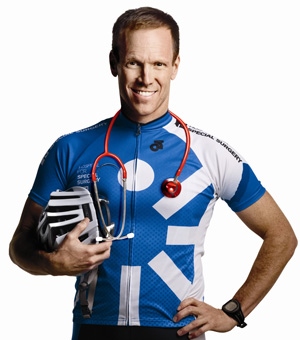
Dr. Jordan Metzl is a Harvard-trained sports medicine physician at the Hospital for Special Surgery in New York City, where he’s treated tens of thousands of runners across every level from first-timers to Olympians. He’s also a 37-time marathon finisher and an Ironman triathlete, the creator of the wildly popular IronStrength workout, and a medical columnist for Triathlete Magazine.
His newest book, Push: Unlock the Science of Fitness Motivation to Embrace Health and Longevity, tackles the question at the heart of our conversation: how do you keep moving — and keep wanting to move — as the years stack up?
Jordan is one of the rare experts who lives the advice he gives, and that shows in how practical his answers are.
Is There Really Tension Between Performance and Longevity?
I opened with the question I most wanted answered: is chasing fast times actually at odds with running for life?
The honest answer is that some of it is. A few of the strategies that produce short-term breakthroughs like increasing weekly mileage, racing regularly, treating every workout as a test, ignoring the small aches can absolutely deliver a PR this year. They can also set a fuse burning that you won’t notice until it’s a chronic problem.
But Jordan’s larger point reframes the whole debate. Performance and longevity aren’t opposites on a slider where more of one means less of the other. They’re built from the same foundation:
- consistent training
- regular weight training
- sleep
- recovery
The masters runner who protects their longevity is usually the one who keeps stringing together healthy years — and stringing together healthy years is precisely how you get faster.
Durability is a performance strategy.
The trap isn’t wanting to run fast. It’s pursuing speed in a way that ignores the 20-year time horizon.
The Common Missteps Masters Runners Make
I asked Jordan what not to do — the mistakes that feel productive but cost you later. A few themes stood out.
Skipping strength training. This is the big one. If you take nothing else from this article, take this: after 40, strength training stops being optional. Age-related muscle loss is real and it’s aggressive — and running alone does not stop it. Strength work is your primary defense.
ACTION ITEM: Follow a good strength program. Your future self will thank you.
Treating recovery as weakness. Younger runners can get away with hammering when they shouldn’t. Masters runners can’t. The body’s ability to bounce back from hard efforts changes with age, and sleep becomes even more central to recovery as you get older. Cheating recovery is cheating your future self.
Ignoring the early warning signs. The runners who develop chronic injuries are usually the ones who trained through the small stuff. A niggle you ignore at 45 becomes the injury that ends a season at 46 — and reshapes how you think about running for years after.
Chasing the shiny longevity gimmicks. Jordan is delightfully blunt here. He’s watched the longevity space fill up with expensive, unproven products like full-body scans or elaborate supplement stacks while the actual proven interventions get overlooked.
He half-jokes that the protein obsession has gone so far we’ll soon see “protein toothpaste.” His prescription is unglamorous on purpose: exercise, sleep, real food, and social connection. Exercise, in his framing, is the most effective, side-effect-free medicine we have. And it’s free.
Why Injury Prevention Is the Whole Game
I told Jordan that so much of masters running seems to come down to reducing injury risk, and he agreed that it’s the hinge everything else swings on.
Injuries don’t just stop you from running. They wreck your momentum, dent your identity, and — worst of all — have a habit of becoming chronic. For a masters runner, an injury isn’t a two-week inconvenience; it can be the thing that quietly ends a running life, because the interruption becomes a stop that never restarts.
That’s why the smartest masters runners over-invest in the boring stuff: strength (at this age, it’s non-negotiable), mobility, sleep, and honest self-assessment. Not because it’s fun, but because staying healthy is the entire ballgame.
You can’t get faster, and you certainly can’t run for 40 years, if you’re always hurt.
Rewiring Your Decision-Making as a Runner
If we want both performance and longevity, we have to change how we make training decisions. This was maybe my favorite part of the conversation, because it’s a mindset shift more than a tactic.
The reframe is simple: stop optimizing for the next race and start optimizing for the next decade. When you’re deciding whether to push through a workout, add a hard race, or ignore a tight calf, ask a different question. Not “will this make me faster this month?” but “does this help me still be running, and running well, in 20 years?“
Those two questions often have different answers — and the second one is the one masters runners should weight more heavily. Sometimes that means backing off. Sometimes it means adding the strength session instead of the extra tempo run. Sometimes it means racing less so you can run more.
This might seem overly cautious while sacrificing your ambition. But after 16 years of coaching experience, I can confidently say that we must aim your ambition at the right target: a long, healthy running life that happens to include plenty of fast times along the way.
The Psychological Side: Can You Stay Motivated for Decades?
Here’s the thing I’m most curious about personally: you can only run into your 70s and 80s if you actually want to. So is it possible to protect that drive across a lifetime?
Jordan’s answer from the podcast (and this is the whole thesis of his book Push) is that motivation isn’t a fixed trait you’re born with or without. It’s something you can understand and cultivate. And crucially, the mental approach that keeps you running for decades usually has to evolve.
The runner who’s driven purely by chasing PRs will eventually hit the age where the PRs stop coming, and that’s a dangerous moment — it’s where a lot of people quit.
The runners who last find deeper, more durable reasons to run: how it makes them feel, the community around it, the identity of being a runner, the sheer joy of moving.
Performance goals are great fuel in your 30s. They’re rarely enough to carry you into your 70s. Building in the intrinsic rewards — and the social connection that comes from running with other people — is what makes the drive sustainable.
What Actually Separates the 40-Year Runner?
I asked Jordan the question I most wanted a straight answer to. After decades of treating runners, what separates someone who’s still training after 40 years from someone who isn’t? Is it genetics, or is it something else?
Genes play a role, sure. But the honest, encouraging answer is that the biggest differences are choices, not DNA.
The lifelong runners are the ones who…
- strength-trained
- respected recovery
- caught injuries early
- evolved their motivation
- kept the basics — sleep, movement, nutrition, community — remarkably consistent over years.
Sustainability in running is less about winning the genetic lottery and more about a series of good decisions repeated over a very long time. That should be empowering, because those decisions are available to every one of us.
BONUS Q&A for Masters Runners
I closed with three quick questions that masters runners ask me constantly.
- How much more important is protein for the older runner?
- Should older runners worry about sarcopenia?
- What are “exercise snacks,” and do they matter if you already train most days?
Subscribe to the podcast to hear Jordan’s answers!
The Bottom Line for Masters Runners
The best thing about this conversation is how hopeful it is. Running well into your later decades isn’t reserved for genetic outliers. It’s built from choices any of us can make: strength train, protect recovery and sleep, catch injuries early, evolve why you run, and keep the basics boringly consistent.
Train hard. Just train in a way that the 80-year-old version of you will thank you for.
Listen to the full conversation with Dr. Jordan Metzl on the Strength Running Podcast (Apple, Spotify) for the complete discussion.
And if you’re serious about running for life, start with the one habit that matters most after 40: get strong (start here).